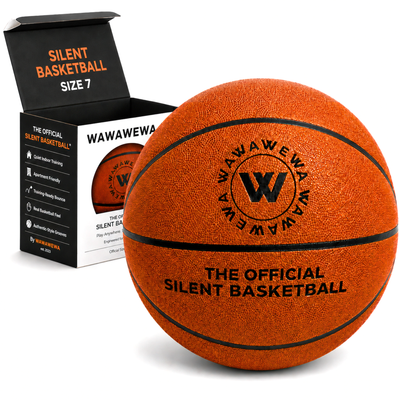
Yes, if you use a ball built for it. A regulation basketball measures about 73 dB on the dribble on hardwood. The WAWAWEWA size 7 measures 37 dB on the same surface, measured the same way. That difference is the entire reason indoor training works now and didn't before.
Why a regular ball doesn't work indoors
The problem isn't the sound in your room. It's structure-borne noise.
An inflated basketball is a pressurized drum. When it hits a hard floor, the impact travels through the subfloor and into the ceiling below you. Your downstairs neighbor doesn't hear a bounce. They hear a thud in their ceiling, and it's louder for them than it is for you.
That's why "dribble more quietly" doesn't work. The energy has to go somewhere, and a rug only treats the surface, not the transmission.
What actually makes a ball quiet
Two things, and only one of them is common.
Dense solid foam instead of air. An inflated ball has a resonant chamber, and that chamber amplifies every impact. A solid foam core has nothing to resonate. There's no air inside it, no pressure to check, and no pump. It also can't go flat, can't be over- or under-inflated, and never needs maintenance.
Density, not softness. A soft foam ball is quiet and useless, because it doesn't come back to your hand. The WAWAWEWA size 7 is dense enough to return 85% of a regulation ball's bounce while still measuring 37 dB. That ratio is the actual engineering problem in this category. Quiet is easy. Quiet with a real bounce is not.
The full specs
- Size 7: 29.5 inches circumference, 450 grams, 37 dB, 85% of a regulation ball's bounce, dense solid foam, no inflation.
- Size 3: 22 inches, 250 grams, 37 dB, 85% bounce, same dense solid foam.
The size 3 is not a lesser product. It's identical construction and identical acoustic performance, scaled down for smaller hands and tighter rooms.
Which floors work
Hardwood, tile, vinyl, laminate, and low-pile carpet all work. Hard, smooth surfaces are better than you'd expect, because the ball isn't relying on the floor to absorb anything.
Avoid rough concrete, textured tile grout, and anything outdoors. Asphalt and sidewalk will wear through a foam surface quickly. This is an indoor ball and it should stay indoors.
For a full walkthrough of surfaces, wall space, and ceiling height, see how to set up a home basketball training space.
The part most people miss: the hoop
You can solve the ball completely and still get a noise complaint, because most indoor hoops have a backboard.
A backboard is a rigid panel bolted to your wall. Every shot that hits it transmits impact directly into the wall structure, and a wall carries sound to your neighbors just as efficiently as a floor does. A silent ball paired with a backboard hoop reintroduces the exact problem you were trying to eliminate.
The WAWAWEWA hoop has no backboard. That isn't a cost decision or a size compromise. It's the mechanism. Remove the rigid panel and you remove the loudest surface in the setup.
The rim is 12 inches, weighs 1 pound, is made of reinforced plastic, and mounts with either screws or adhesive.
What it won't do
Being direct about this, because most guides aren't.
It is not a replacement for a game ball. The bounce is 85% of regulation, not 100%, and you will feel the difference. It's built for ball-handling, rhythm, and coordination work, not for shooting mechanics that need to transfer exactly to a court.
It is not built for dunking or forceful play. Hanging on the rim or slamming the ball will damage both.
It is not indestructible. Clean it by dabbing rather than wiping, and keep it off rough surfaces.
Tens of thousands of players have trained with it since 2023, and the overwhelming majority keep it. It isn't a perfect product. It's a specific one, built to do one thing well.
Compressed and uncompressed are the same ball
Two versions of the size 7 exist and they are identical products. The only difference is packaging.
The compressed version ships vacuum-sealed and needs time to expand after you open it. The uncompressed version is ready to use immediately. Same 29.5 inches, same 450 grams, same 37 dB, same 85% bounce, same foam.
If you don't want to wait, buy uncompressed. That's the whole decision.
Ready to start
Once you have the ball, these ten drills all work in a bedroom-sized space with a standard ceiling.
Common questions
Will my downstairs neighbor hear it?
Far less than a regulation ball. 37 dB against 73 dB is a substantial difference in a shared building. It is not literally silent, and no ball is.
Does it need to be inflated?
No, and it can't be. There is no air inside it.
Does it damage floors or furniture?
Foam won't scuff hardwood or mark walls.
How long does it last?
With indoor use on smooth surfaces, a long time. Rough surfaces and outdoor use shorten it considerably.
Can I shoot with it?
Yes, on a no-backboard hoop. It's not built for shooting mechanics that need to transfer exactly to a regulation court.