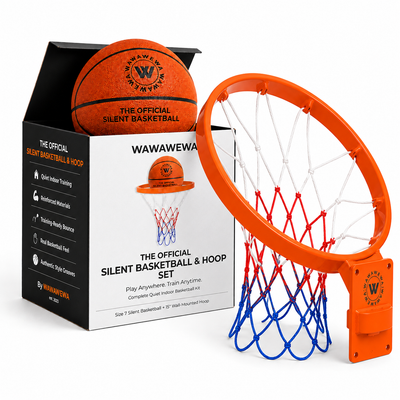
Every drill below works in a space roughly the size of a bedroom, with a standard ceiling, using a silent basketball. All ten are stationary or near-stationary, which is what makes them apartment-viable. None require a hoop.
Before you start
Clear a square of floor about six feet on a side. Hardwood, tile, vinyl, laminate, or low-pile carpet all work.
Move anything fragile out of arm's reach. Most indoor accidents are a lamp, not a floor.
Use a ball built for it. A regulation basketball measures about 73 dB on hardwood. The WAWAWEWA size 7 measures 37 dB. On a hard floor in a shared building, that difference is what makes 10pm reps possible.
The ten drills
- Pound dribble, strong hand. Stationary, knees bent, dribble hard at about waist height. 30 seconds. The goal is force and control, not speed.
- Pound dribble, weak hand. Same thing, other hand. Most players are notably worse here, which is exactly why it's on the list. 30 seconds.
- Low pound. Drop your stance and dribble below knee height. Harder than it looks and it builds the control you need in traffic. 30 seconds per hand.
- Stationary crossover. Ball from hand to hand in front, low and quick. Keep your eyes up. 45 seconds.
- Between the legs, stationary. Step forward slightly, push the ball through, catch on the other side. Alternate lead legs. 45 seconds.
- Behind the back, stationary. Slower than the crossover and mostly about wrist control. 45 seconds.
- Figure eight. Weave the ball around and between your legs in a figure-eight pattern without dribbling. Pure hand speed and coordination. 45 seconds.
- Wraparound. Pass the ball around your waist, then your head, then your knees, without dropping it. Reverse direction halfway. 60 seconds.
- Spider dribble. Feet apart, knees bent, tap the ball rapidly with alternating hands in front of and behind your legs. The hardest drill here. 30 seconds.
- Fingertip taps. Arms extended overhead, tap the ball between fingertips. Not a dribble drill, but it builds the finger strength every other drill depends on. 60 seconds.
Putting it together
Run all ten back to back and you have roughly an eight-minute session. Done three or four times a week, it's meaningful volume, and it's volume you weren't getting otherwise.
Start with two rounds. Add rounds before you add speed.
What not to do indoors
- No dunking. The ball and the hoop are both built for controlled play, not force.
- No full-speed drives. You'll run out of floor before you run out of momentum.
- No shooting into a backboard hoop. A backboard is a rigid panel bolted to your wall, and every shot transmits impact straight into the wall structure. That's the noise a silent ball was supposed to eliminate. The WAWAWEWA hoop has no backboard for exactly this reason.
Adding a hoop
None of the ten drills above need one, but shooting reps are the natural next step.
The WAWAWEWA hoop has a 12-inch rim, weighs 1 pound, is reinforced plastic, and mounts with screws or adhesive. No backboard, by design.
For placement, wall selection, and mounting, see how to set up a home basketball training space.
Common questions
How much space do I actually need?
About six feet square for all ten drills. Ceiling height only matters if you add shooting.
Will these drills transfer to a real court?
Handle work, hand speed, and weak-hand development transfer well. Shooting mechanics don't transfer as cleanly from a lighter ball, so calibrate those with a game ball.
Can I do these on carpet?
Low-pile carpet works. High-pile kills the bounce and makes the reps ineffective.
What size ball should I use?
The size 7 at 29.5 inches and 450 grams for most people. The size 3 at 22 inches and 250 grams for smaller hands or tighter rooms. Both measure 37 dB and both return 85% of a regulation ball's bounce.
Is this enough to actually improve?
For ball-handling, yes. Repetition is most of it, and these drills give you repetition on days you can't get to a gym. For a fuller picture of what does and doesn't carry over, read silent basketball vs regular basketball.